|
|
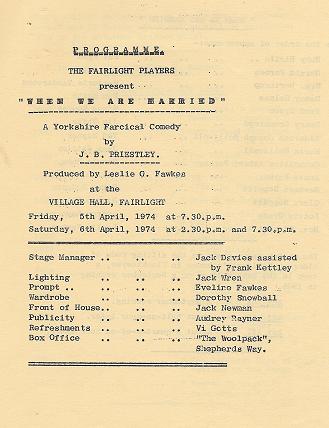
When We Are Married
A Yorkshire Farcical Comedy by
J.B. Priestley
Produced by Leslie G. Fawkes |
|
Ruby - You'll have to wait, 'cos they
haven't finished their tea.
Gerald - Bit late, aren't they?
Ruby -
It's a do.
Gerald - It's what?
Ruby - A do. Y'know, they've
company.
Gerald - Oh, I see. It's a sort of party, and they're having
high tea.
Ruby - Roast pork, stand pie, salmon and salad, trifle,
two kinds o' jellies, lemon-cheese tarts, jam tarts, swiss tarts,
sponge cake, walnut cake, chocolate roll, and a pound cake kept from
last Christmas.
Gerald (with
irony) - Is that all?
Ruby
(seriously) - No,
there's white bread, brown bread, current teacake, one o' them big
curd tarts from Gregory's, and a lot o' cheese.
Gerald - It is a do,
isn't it? |
 |
Cast |
| Ruby Birtle |
Pat Wynn |
| Gerald Forbes |
Del Smith |
| Mrs. Northrop |
Marjorie Vandervord |
| Nancy Holmes |
Pam Smith |
| Fred Dyson |
Nicos Bouras |
| Henry Ormonroyd |
Jim White |
| Alderman Joseph Helliwell |
Ted Rayner |
| Maria Helliwell |
Joan Kettley |
| Councillor Albert Parker |
Donald Hume |
| Annie Parker |
Lillian Webb |
| Herbert Soppitt |
Percy Hodgson |
| Clara Soppitt |
Binkie Holmes |
| Lottie Grady |
Audrey Rayner |
| Rev Clement Mercer |
Leslie Fawkes |
|
|
 |
 |
|
|
The action takes place in the sitting room of
Alderman Helliwell's house in Clecklewyke, a town in the West Riding
of Yorkshire, on a September evening in
1908.
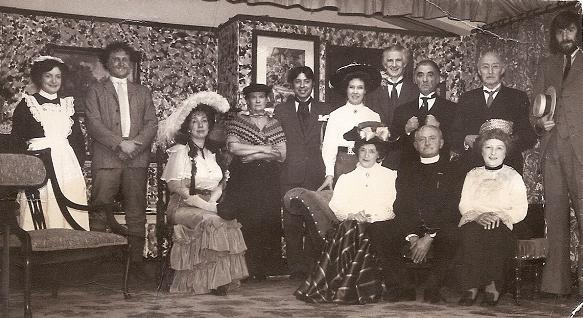
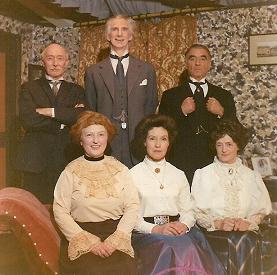
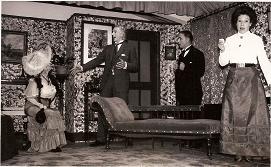
Another large cast, this time 14 strong.
One of the ladies is missing from the cast photo (top), but I haven't
yet worked out who. Strangely, I note from the script that, when the
play was first performed in 1938 (with Patricia Hayes in the role of
Ruby Birtle), there was also a part for the Mayor of Clecklewyke.
Presumably his appearance was not crucial to the plot, since he
appears subsequently to have been written out of the
script.
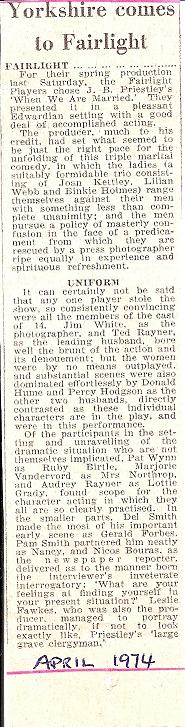
The cast on this occasion was made up
entirely of the "old faithfuls", all of whom, according to the
review (left) acquitted themselves admirably.
There is little that I can add to what the
review says, but I was intrigued to discover the following short
report on the reverse side of the cutting.
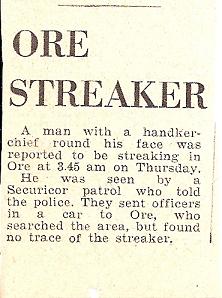
Whatever happened to the noble pursuit of
streaking? One never seems to hear of it these days!
|
|
|
|
|
|
|
|
|
|
|
|
|
|
|
|
|
|
|
|
|
|
|
|
|
|
|
