|
|
Search By Night
A Play in Three Acts by Victor
Lucas
Produced by Dorothy Snowball |
|
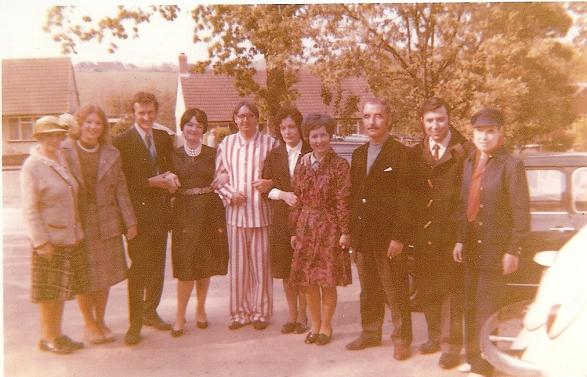
I have yet to identify the members of the
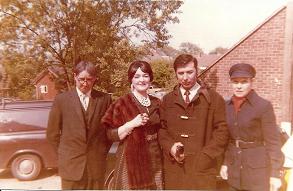
cast, but the rear end of a Volkswagon Beetle is unmistakable, as is
the Mini behind it. The other vehicle is probably a Ford Thames van,
which you can tell from the line of the roof - just kidding - you
can see a bit more of it in the picture below. As for the cast - ask
me later.
Note
- we were delighted to hear from Peter Hume, who was able to identify
his father, Donald, third from the right in this picture-.
I'm not quite sure how Peter stumbled across the site, but am very glad
that he did so. |
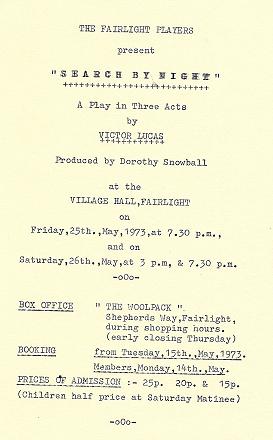 |
Cast |
| Elizabeth MacAllister |
Sally Kinnes |
| Molly Casey |
Anne Graham |
| Miss Wilberforce |
Lilian Webb |
| Pargetter |
Bob Held |
| Steve MacAllister |
Donald Hume |
| David Stewart |
Jim White |
| Price |
Pat Wynn |
| Serafina |
Mary Davies |
| Joan Gillman |
Joan Kettley |
| Nick Afton |
Nicos Bouras |
|
|
|
|
|
|
| The play
is set towards the end of October in
the early 1960s. The action takes place in the
library of "Rushcliffe", a seventeenth century manor house on the
Sussex coast. |
|
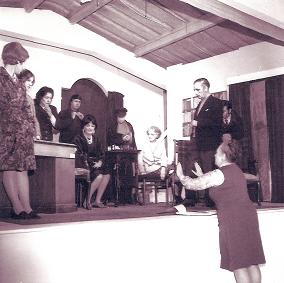
This was the first production to take place on
the new stage in the larger hall. I understand that the new hall was
built during the 1960s, and that the original grand scheme included
changing rooms below the stage and various other new facilities.
However, the money ran out and the result was a somewhat "slimmed
down" addition. It was not until the early 1970s that the money was
found to extend the hall lengthways and add the stage area as we
know it today. What the stage lacks in terms of lighting and
gadgets, it makes up for in tidiness and simplicity. I'm sure that
it felt like a major step forward for those involved at the
time. |
|
|
 |
 |
|
|
|
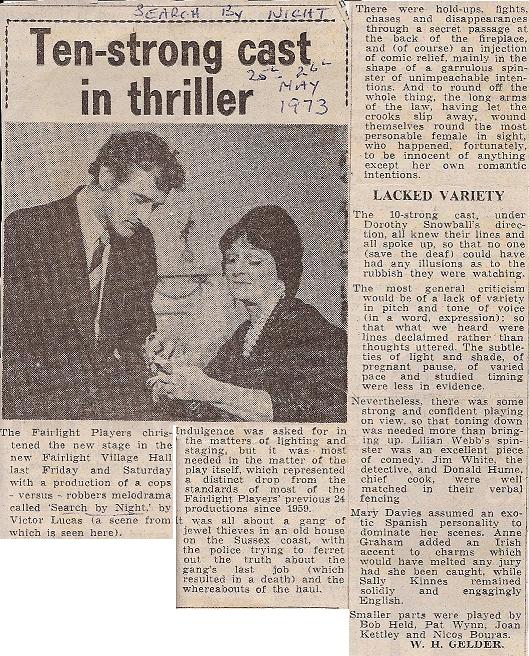
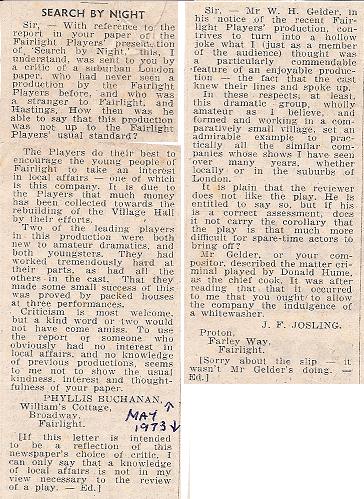
A crabby critic
Sadly, it appears that Mr. Gelder, who wrote
the review (above) had eaten something that disagreed with him.
Whether he had seen any previous performances by the Fairlight
Players, and was thus in a position to comment on the
relative standard of this production, is not actually
known. Either way, some of his comments were needlessly hurtful, and
probably say more about his disposition than they do about the play.
If it was as bad as he makes out, it would certainly be a surprise,
given the glowing reports of previous plays performed under the
guiding hand of Dorothy Snowball.
As the items on the right clearly show, the
group's regular supporters do not take, what they consider to be,
undeserved criticism lying down. These letters appeared in a
subsequent issue of the local paper.
If Mr. Gelder's article did any damage at
all, I suspect that it was more likely to be to the circulation
figures of the Hastings Observer rather than the level of support
for the Fairlight Players. |
|
|
|
|
|
|
|
|
|
|
|
|
|
|
|
|
|
|
|
|
|
|
|
|
|
|
